



|
Demographics
Bankhead Middle School in Walker County, Alabama, serves 243 students, grades 5 through 8. Dedicated administration, staff, and classroom teachers work to “develop the whole child to ensure success.” Since beginning work with the HRS framework, Bankhead has achieved certification at levels 1 and 2.
243 students
- 61.3% free or reduced lunch
- 1.7% English learners
- 23.1% students with special needs
Bankhead Middle School's Challenge
Bankhead Middle School is a traditionally high-performing school, with reading and math scores that rank above district and state averages. Never satisfied with status quo, Principal Amber Freeman and her team at Bankhead continue to seek ways to not only maintain their strong results, but also to improve and ensure that every student shares the school’s success.
When district leaders brought the High Reliability Schools (HRS) framework to her attention, Freeman recognized its potential to support and structure her school’s initiatives. HRS Level 1, which focuses on a safe, supportive, and collaborative culture, was especially impactful at the middle school level, where students undergo significant social, physical, and academic changes in a short span of time.
Bankhead’s faculty and staff sought to assist students most at risk—those facing challenges with behavior, home life, or attendance that impacted their academic performance. Believing these students would benefit from more individualized support and personal connections, they designed and implemented a teacher-student mentoring program.
Bankhead’s leaders also aimed to improve the instructional capacity of their teachers. HRS Level 2 emphasizes effective teaching in every classroom. To ensure consistency and a common understanding of instructional practices and expectations, Bankhead focused on developing and mastering their own instructional model.
Implementation
“We feel like proud parents.””
Bankhead educators customized their mentorship program and instructional model to fit their unique needs rather than using out-of-the-box solutions. Grounded in research, the HRS framework supports this adaptive approach and emphasizes continuous monitoring and improvement--practices that Bankhead leaders have also adopted.
The school’s mentorship program, “Boosting Motivation and Success” (BMS), began informally and evolved by adapting data-driven models to fit students’ needs. Students with discipline or home life challenges who are not already receiving other services are referred by teachers, and mentors choose their mentees. Mentors meet weekly with one or two students, focusing on patience, positivity, and high expectations to foster positive relationships that motivate improved behavior, attendance, and academics. The program continues to be refined to maximize mentor impact, including shifting attendance-related support to the school counselor.
For instruction, Bankhead adapted 16 elements from Dr. Robert Marzano’s New Art and Science of Teaching (NASOT) model, aligning them with the state teacher evaluation system. Teachers take ownership by mastering and presenting elements. Their work is supported by Avanti, a library of professional learning videos made by teachers for teachers, as well as further professional development from Marzano Resources associates. Individual growth goals, Avanti’s virtual platform, collaborative learning rounds, and scheduled collaboration time helped teachers improve their skills and collectively ensure student success
Results
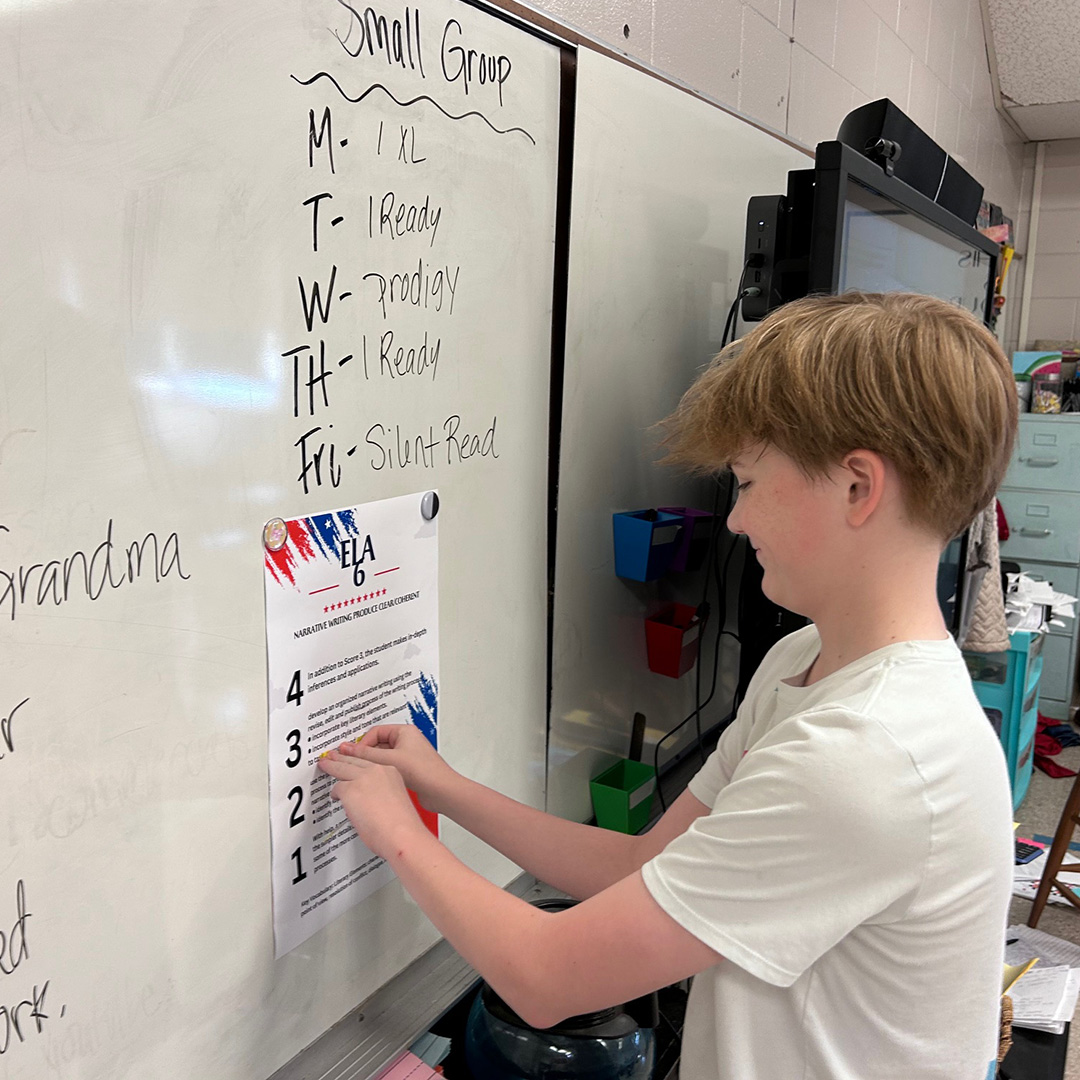
A student uses proficiency scales in Mrs. Chatham's classroom
While Bankhead leaders recognized their initiatives were making a positive difference, they sought to quantify these impacts more precisely, as encouraged by the HRS certification process. “We had the realization that we needed to put some numbers to it,” Freeman said.
For the mentorship program, data was collected on discipline, academic achievement, and attendance. Since the 2021–2022 school year, 96% of participating students experienced growth in at least one area, and 76% improved in two or more areas. Academic improvement was the most significant, with 77% of mentees raising their letter grades in at least one subject.
To monitor implementation of their instructional model, Bankhead tracked the use of model elements during classroom walkthroughs. By 2025, all elements were observed schoolwide, with teachers demonstrating steady progress.
These improvements in student support and instruction contributed to gains in state accountability measures and student achievement. Chronic absenteeism dropped from 17.2% in 2022 to 4.9% in 2024—well below the Alabama state average of 14.84%. Among the cohort of students who completed 5th through 8th grade at Bankhead from 2021 to 2024, proficiency on the Alabama Comprehensive Assessment Program (ACAP) increased from 43.1% to 66.7% in English language arts and from 34.7% to 36.6% in math.
Implementing, monitoring, and refining initiatives within the context of the HRS framework has allowed Bankhead Middle School to maintain and improve high standards for the students they serve. “We feel like proud parents,” Freeman said.
Chronic absenteeism at Bankhead Middle School
ELA proficiency at Bankhead Middle School (grade level cohort)
Why High Reliability Schools?
Dr. Marzano’s vision for K–12 education is simple: the vast majority of schools can be highly effective in promoting student learning. To show how, he created the Marzano High Reliability Schools framework. This framework, based on 40 years of educational research, defines five progressive levels of performance that a school must master to become a high reliability school—where all students learn the content and skills they need for success in college, careers, and beyond.


